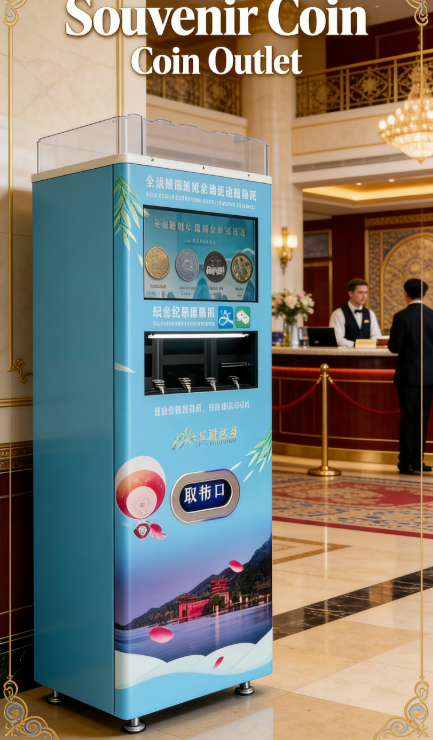
Walk past the t-shirt rack at a family entertainment center in the San Fernando Valley on a Saturday and you will see forty folded tees in eight sizes, three of them touched since Tuesday.
Now look at the exit. A kid pulls a handle on a machine the size of a luggage cart, the die comes down, a coin drops into the tray, and the family stands there forty seconds longer than they planned to.
That forty seconds is the whole business model.
This is a plain answer for Los Angeles operators weighing a souvenir coin press machine — also called a penny press machine or elongated coin machine — on whether it earns its floor space and where the buying process goes wrong. It is written by a manufacturer, so read the China section with suspicion.
WHY THE CHEAPEST SKU MAKES THE MOST MONEY
A pressed coin sells for a couple of dollars. A hoodie sells for $24. Margin is not ticket size, and the coin press wins on every line of cost:
No sizing, no dead stock. One design is one die. You stock blanks, not finished goods — the guest makes the souvenir on the spot. Almost no labor. The machine is the cashier. Someone loads blanks and empties the box once a day. Tiny footprint. It monetizes a corner that cannot hold a redemption game. No markdown season. A design that stops selling gets retired, not discounted to 50%. No returns, no fit complaints, no gift wrap.
If you are looking for FEC revenue ideas that need neither another game tech nor another 200 square feet, this is why the category keeps coming up.
THE COLLECTOR EFFECT
Elongated coins are not a short-tail impulse buy — they are a hobby with infrastructure. PennyCollector.com keeps a crowd-sourced map of machine locations worldwide, and collectors plan stops around it.
So you are not waiting for a guest to notice a machine by the exit. You are publishing a design people seek out and then tell other collectors about. Which gives you the one rule that decides everything: make it impossible to find anywhere else. A generic beach scene is a coaster. "Los Angeles, 2026" pressed only at your venue is a collectible.
WHERE IT WORKS IN LOS ANGELES
Santa Monica Pier and Third Street Promenade — high traffic, high souvenir intent, international guests. Hollywood Boulevard — tourist density no other US street matches. Design angle: stars, the theatre facade. Griffith Observatory, Natural History Museum, La Brea Tar Pits — museum gift shops are natural homes; the guest just learned something and wants a piece of it. LA Zoo, Aquarium of the Pacific — families, low price tolerance, high photo sharing. FECs and arcade bars in the Valley, South Bay and Orange County — not a souvenir play here, a redemption-adjacent revenue line that costs you a corner. Convention weekends — Anime Expo and Comic Con pull exactly the demographic that collects pressed coins.
SIX PAIN POINTS THAT COST OPERATORS MONEY
Per-cap is capped by your floor plan. Admissions are fixed by capacity and F&B has a ceiling. Fix: add revenue that needs one square foot, not two hundred.
Downtime you cannot schedule. A machine that dies in July is a revenue hole, and imported parts do not arrive on your timetable. Fix: buy the spare parts kit — die set, coin mechanism, springs, belts — and get the consumable list in writing.
Distributor pricing with no breakdown. You get a number, not a cost structure, so you cannot tell where the margin sits. Fix: demand a line-item quote — machine, tooling, extra dies, crating, door-to-door freight, certification.
Souvenirs Amazon sells cheaper. A guest price-checks a magnet in ten seconds. Fix: sell what cannot ship from a warehouse — made on site, dated, tied to a place.
Custom design feels impossible at low volume. Minimum orders kill the exclusivity that makes the machine work. Fix: treat die tooling as a separate one-time cost and ask for a physical proof press, not a Photoshop file.
Install-day surprises. Wrong plug, wrong voltage, no certification, a control height that fails inspection. Fix: put 110V/60Hz, UL or ETL, and ADA reach range on the purchase order — not in a chat message.
WHAT "MADE IN CHINA" ACTUALLY MEANS
Panyu District in Guangzhou and the surrounding Pearl River Delta is where a large share of the world's arcade equipment is built. Dies, coin mechanisms, plating and cabinetry sit within a short drive of each other, which is why a design change can be a same-week conversation instead of a quarter-long project.
Factory direct versus importer: a US distributor adds freight, duty, warehousing, local support and margin. That is legitimate — when your machine dies, someone local answers the phone. What is not legitimate is paying distributor pricing without distributor service.
Quality is the die, not the cabinet. The cabinet is sheet metal and paint; almost anyone gets that right. The die is tool steel, engraving depth and heat treatment, and it decides whether you get 10,000 clean presses or 2,000 smeared ones. Ask for die material and expected press life in writing.
Freight, honestly: Yantian to the ports of Los Angeles and Long Beach runs roughly 14 to 17 days port to port, three to four weeks door to door. Which is fine — until peak season. Work backward from your install date, not forward from your PO.
REAL CASES
Case 1: [venue type], [city] — runs [what they operate], added [machine and design] in [month/year], now at [X presses per 1,000 visitors / $Y per month], paid back in [Z months]. "[short operator quote]"
Case 2: [venue type], [city] — [what they added], [what changed]. "[quote]"
PAYBACK MATH
Annual revenue = daily visitors x attach rate x price per press x operating days
Illustrative only — swap in your numbers: 300 visitors at 3% and 3is9pressesaday,9,450 a year. 800 visitors at 4% is 32 a day, 33,600.1,500at578,750.
Measure presses per thousand visitors, not total presses. If it does not clear your hurdle at half your traffic, do not buy it.
FAQ
How much does one cost? It depends on design count, crank versus motorized, and custom tooling. Ask for machine, tooling and freight quoted separately so you can compare suppliers on equal terms.
How long does a die last? Varies with material and volume — which is exactly why you ask for an expected press count in writing, and treat dies as a consumable.
Where do I put it? Near the exit or the register, where guests have finished the experience and are still holding their wallets. Visibility beats raw traffic.
SO, IS BUYING FROM CHINA THE RIGHT ANSWER?
Buy from a Chinese factory when you need tooling flexibility — your own die, a small run for one venue, a seasonal design you can change in weeks — and your volume is enough that the unit price difference covers freight and inventory risk.
Buy locally when what you actually need is same-week service and a phone number that answers.
What never works is the middle: factory prices paid to a reseller who still cannot replace a die before Labor Day. The machine was never the product. The die is. The placement is. The exclusive design is. Everything else is metal and paint.
If you run an LA venue with a corner doing nothing, one question is worth asking this week: what would you put on the coin that nobody else in the city has? That design is your moat. Everything after it is arithmetic.
Send your venue type, daily foot traffic and the corner you have in mind, and you will get a line-item quote plus a payback model built on your numbers. One machine is enough to find out whether the category works.
#SouvenirCoinPressMachine #PennyPressMachine #ElongatedCoinMachine #CoinPressMachine #ArcadeEquipment #FECRevenueIdeas #CoinOperatedMachine #LosAngelesAttractions #FamilyEntertainmentCenter #MadeInChina #GuangzhouManufacturer #VendingMachineBusiness